Segovia, capital of Segovia provincia, in the comunidad autónoma ("autonomous community") of Castile-León, Spain, northwest of Madrid. An Iberian settlement from about 700 BC, it was taken in about 80 BC by the Romans. It was occupied at the
beginning of the 8th century by the Moors, from whom Alfonso VI recaptured it in 1079. Thereafter the city enjoyed prosperity and a position of some importance in medieval Castile, serving as a royal residence during the reign of Alfonso X the Wise (c. 1284) and as the site of the Spanish mint from
1586 until 1730. It is the city in which Isabella was proclaimed queen in 1474. An outbreak of plague at the end of the 16th century ushered in a long period of decline, but the city's fortunes revived with the railway-building era of the 19th century.
There are two well-differentiated areas in Segovia: an upper town encircled by ancient walls situated on the narrow limestone ridge between the two rivers, and a lower part outside the walls. The centre of the old town is the Plaza Mayor, site of the 16th century Gothic cathedral,
from which streets lead into the outer suburbs. Crossing the Plaza del Azoguejo, the focal point of traffic, is the Roman aqueduct known as El Puente, one the the finest and best-preserved examples of its kind.
Notable churches include those of San Esteban (with a superb tower), San Martín, La Trinidad, San Lorenzo, and San Millán, all Romanesque and from the 12th century; and Vera Cruz (13th century), the former church of the Knights Templars. The Romanesque Church of San Justo is notable for its valuable
12th century paintings. The Alcázar, mentioned as early as the 12th century, was the fortified palace of the kings of Castile; the original building was mostly destroyed by fire in 1862 but has since been extensively restored. Segovia also has an artillery academy in the former
Convent of San Francisco and has several museums.
In the late Middle Ages Segovia was the centre of a flourishing textile industry, which declined; agriculture took its place. The city now has many factories. Pop. (1986 est.) 53,526
 Jewels of Spain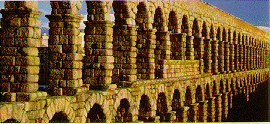

 Back to Jewels of Spain