Santiago, in full Santiago de Compostela, city, La Coruña provincia, in the comunidad autónoma ("autonomous community") of Galicia, northwestern Spain, near the confluence of the Sar and Sarela rivers, 32 miles
(51 km) southwest of La Coruña city.
Santiago is the Spanish for St. James, whose shrine the city possesses. In AD 813 a tomb discovered at nearby Padrón was said to have been supernaturally revealed to be that of the apostle St. James the Great, martyred at Jerusalem in about AD 44. His bones had
been taken to Spain, where, according to legend, he had formerly evangelized.
The discovery of the relics provided a rallying point for Christian Spain, then confined to a narrow strip at the north of the Iberian Peninsula, most of which was occupied by Moors. Over the tomb Alfonso II of Asturias built an earthen church that Alfonso III replaced by a stone
one, and the town that grew up around it became the most important Christian place of pilgrimage after Jerusalem and Rome during the Middle Ages.
The whole town, except the tomb itself, was destroyed in 997 by Abu 'Amir al-Mansur (Almanzor), military commander of the Moorish caliphate of Córdoba.
The medieval city is virtually intact, with layrinthine cobbled streets leading to the Main Plaza del Obradoiro. The great Cathedral, begun by order of Alfonso VI of Leon and Castile in 1078, consecrated in 1128 and completed in 1211, dominates the town -its main entrance is two stories above the plaza. The towers soar into the sky. The Portico de la Gloria,
designed by Maestro Mateo and completed in 1188, is the finest example of Romanesque sculpture. Its three arches depict biblical characters, including St. James. The Maestro's face is on one of the columns, worn by the fingers of the faithful who touch it to pay tribute. The other doors and entries are also intricately carved.
Inside the Cathedral are more priceless architecture, statues and religious treasures. Behind the silver and gold main altar are the sarcophagi of St. James and two of his disciples. A statue of St. James stands above, surrounded by an elaborate display of drapery and sculpture. The pilgrim has completed his journey upon kissing the hem of the jeweled cloak that drapes the statue.
There is a museum displaying the rest of the Cathedral's treasures.
At the north of the Plaza Mayor is the Hospice of the Catholic Kings (Hospicio de los Reyes Católicos), built in 1501-11 by Enrique de Egas to receive the pilgrims and later used as a hotel. Other noteworthy secular buildings are the colleges of San Jerónimo (founded 1501), Fonseca (founded 1530), and San Clemente
(founded 1601) and the University (founded 1532, though the building dates from 1750). The Monastery of San Martín Pinario, now a seminary, was founded in the 10th century and rebuilt in the 17th. The Monastery of San Francisco was supposedly founded by St. Francis of Assisi when he made a pilgrimage to Santiago in 1214. The Church of Santa María Salomé and collegiate
church of Santa María la Real del Sar in the suburbs both date from the 12th century, with later facades.
This World Heritage City is a busy tourist town, with pilgrims and visitors wandering through the streets, absorbing the medieval atmosphere. It is most popular from July 15-31, when the Feast of St. James is celebrated with ceremonies and processions.
El Camino de Santiago Monster site about El Camino. Hours of reading about the topic and the Medieval Spain art, literature and culture. By Stephen B. Raulston , Dept of Spanish at the University of the South Sewanee
 Jewels of Spain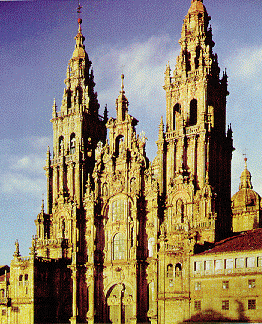

 Back to Jewels of Spain