The Aljama Mosque of Córdoba is a monument which shows all the original features of the caliphal style, fully justifying the decision in 1982 to protect it as a monument of national importance and to put it on the World Heritage List in 1984. Its use as a place for meeting or
conversing (ie, Aljama) points to its true dimension which was not confined to prayer alone.
It is the second most famous structure in Spain remaining from the days of the Moorish occupation. Its founder, Abderraman, intended that its grandeur surpass all other mosques.
Built during the eighth century A.D., the Mezquita covers six acres with over 800 pillars supporting red and white striped arches. To one side of the mosque is the sacred Mihrab,
where the Koran was kept, with three exquisitely carved domes decorated in a golden tone with tiles and mosaics. Yet the mosque did not escape Christian influence. Its center was
destroyed in the 16th century to build a massive, ornate Gothic-Baroque-Rococo cathedral.
The Mosque occupies a rectangular surface area of 23,400 m2. It has a large inner court or
patio with a roofed temple, which is third in size in the world. Its construction was begun by Abd al-Rahman I in 785 after pulling down the Visigothic Church of San Vicente.
It was enlarged by Abd al-Rahman II in 833, by Al-Hakam II in 961 and by Almanzor in 987, who almost doubled its size to what it has been ever since.
Between the 13th and 18th c, it was transformed to a varying degree as a result of having been consecrated to the Christian cult. The most far-reaching change was the great cathedral,
which was begun in 1523 and finished in 1776.
The Mosque retains two outstanding features: its orientation and the off-centre position of the mihrab in the qibla (ie, the south-facing holy wall).
Following Islamic custom, the wall should be Mecca-orientated, but in the case of the Córdoba Mosque it runs from north to south with a south-east diversion. The nostalgia in
Abd al-Rahman I's poems has been seen as the reason for this orientation which coincides with that of the Damascus mosques. The controversy brought about at the time by Al-Hakam II's plan
to correct the error came to an end by leaving it as it was when a wise Muslim scholar of the law at the moment of deciding the question invoked the maxim: "He who follows tradition, does right;
he who gives himself to novelties will fail".
The off-centre position of the mihrab was the result of Almanzor's enlargement which per force had to be made on the east side since it was bounded by the Guadalquivir in the south and by
the palace of the Caliph in the west.
Source: tourist booklets edited and published by Turespaña
Related Internet Links
World Heritage List - Spain Cultural and nature sites in Spain
listed in The World Heritage List, and thus chosen as 'heritage of the world' sites by the International Convention of the Unesco (Eng)
 Jewels of Spain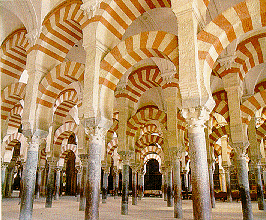

 Back to Jewels of Spain