Today the palaces of La Alhambra are reached along a route similar to the one used in the 14th and 15th c, which was discovered in the course
of excavations in search of the original one.
From Las Armas Gate on the north side or La Justicia Gate in the south, a street rebuilt inside the walls
leads to the small square of the ruins of the first inner court and the mosque and from there to Los Aljibes Sq. The visit of La Alhambra which begins at
this point takes place chronologically.
La Alcazaba lies at the western end of La Sabika. It is the oldest building of the site and predominantly military in character. Its almost completely destroyed watch-tower
dates from the 9th c. Around it, Muhammad I built his residence in the 13th c, probably in the Keep, which faces east. From La Vela Tower in the west, there is a view of the whole town.
Especially beautiful is Las Armas Gate. Apart from the different rooms of La Alcazaba (ie, Moorish fortress), a visit should include the huge underground water storage tank (ie, aljibe) built by the
Catholic Monarchs.
The Muslim custom of successively building palaces was probably the reason for the disappearance of the 13th-c ones which had to make room for those of Yusuf I and Muhammad V in the 13th c.
The latter are admirable despite the fact that they are the result of several juxtapositions. From Los Aljibes Sq in the north begins the visit of the palaces by way of the Mexuar, an area built by
Ismael I for the administration of justice.
It was remodelled by Muhammad V, and Carlos V added an inner court or "patio" to it to make it a chapel. Later it was connected with an oratory containing a mihrab facing
towards Mecca. Beyond the patio lies el cuarto dorado (ie, golden room), the Renaissance ceiling of which was commissioned by the Catholic Monarchs.
Opposite this room there is the facade of the Palace of Comares by Muhammad V, a masterpiece of La Alhambra. The decorative skirtings with geometric patterns are broken by two identical doors with lintels, one
leading to the administrative area and the other to the royal residence. The rich, well-executed decoration is superb
Los Arrayanes Courtyard comes next. It is very large and runs from north to south. Its rectangular pool is framed by two porticoes with seven arches and marble columns.
From the northern portico La Barca Hall (from Barakha: blessing) is reached and the Comares Tower with the Ambassadors or Throne Hall. The Ambassadors Hall is the largest of La Alhambra in
two senses: because of its surface area, with room enough to build nine chambers in its walls, among them that of the sultan, and because of its sumptuosness which is not detrimental, however, to its harmonious balance.
The decoration is of the times of Yusuf I. Especially outstanding is the coffered ceiling of carved cedar wood, where 105 different stars, arranged in seven groups presided by the key star, symbolize the seven Islamic heavens. Its
walls are a real symphony of decorations with plant motifs, inscriptions from the Koran and skirtings of glazed tiles with brilliant metal reflections. This is where the audiences and official ceremonies of the court took place.
Next to Los Arrayanes Courtyard, but running from east to west, Los Leones Palace lends even more magnificence to La Alhambra
It was built by Muhammad V as a private residence and consists of four independent halls around the most famous courtyard-cum-garden in La Alhambra: Los Leones Courtyard named after the twelve stone lions which pour the water
from the fountain into the channels of its rectangular plan. A poem by Ibn-Zamrk carved into the basin of the fountain describes the sophisticated supply and draining system. The whole courtyard is arcaded all round, the arches rest
on marble columns and are a prodigious work of interlaced plaster. The niches along the shorter sides combine water jets with semispherical cupolas.
Los Mocarabes Hall, which borders on Los Arrayanes Courtyard, from where one comes, owes its name to its original cupola which was later replaced by a Baroque ceiling.
Los Abencerrajes Hall in the south has a marble fountain associated in the legend with the slaying of the Abencerrajes, an Arab family involved in the internal struggles for power.
Los Reyes Hall is divided into three square rooms interconnected by splendid arches. In the cupolas of the rooms, paintings on leather are preserved depicting Nasrid monarchs. Their origin and creed - Arab or Christian - has been the
subject of controversy because of their peculiarity.
Las Dos Hermanas Hall is considered the riches in the palace. This is borne out by the inscriptions on its walls, reproducing verses by Ibn-Zamrak, the letters of which used to be covered by the purest gold leaf and the plant motifs with
lapis lazuli, the glazed tiles of the skirtings with metal reflections, the complicated arabesque designs and the splendid cupola with prism patterns.
A large arch leads to the equally beautiful Los Ajimeces Hall and famous Mirador de Daraxa, from where there used to be a view of the Garden of Lindaraja, the valley of the Darro and El Albaicín before the rooms built by Carlos V blocked the view to the garden.
The walls of La Alhambra have 22 towers, some as part of the fortifications, such as the Bermejas Towers of the times of La Alcazaba which they protect on the southern flank, and others which are really residential constructions.
Especially outstanding on the northern side, but east of Lindaraja Garden, is Las Damas Tower next to El Partal Palace, of which only a beautiful portico remains, while El Partal Gardens and an oratory lie at the foot of both.
Beyond El Mihrab Tower, La Cautiva Tower and Las Infantas Tower are two small remarkable palaces. Los Picos and El Candil Tower used to protect Hierro Gate which connected La Alhambra with El Generalife.
In the southern wall, there are Siete Suelos Tower and La Justicia (or La Explanada) Gate, at the end of which stands the Renaissance Las Granadas Gate ascribed to Pedro Machuca.
Source: tourist booklets edited and published by Turespaña
 Jewels of Spain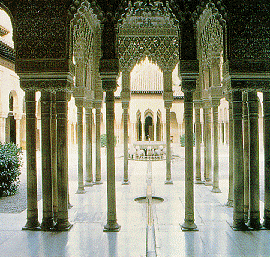

 Back to Jewels of Spain