Summer Festivals: San Juan (St John)
Home  Spanish Fiestas Summer Festivals San Juan / St John
With regard to the origin and meaning of the feast of San Juan, many varying opinions have been put forward. In his book
Seasons of love. Popular festivals dedicated to San Juan, Julio Caro Baroja points out that ... the celebrations
which coincide with the summer solstice have inherited a number of practices, rituals, and customs which seem to be based on
one or more pre-Christian celebrations. In any case, to say that we are studying the "feast of the summer solstice" is taking
things a little far, since the Baptist and baptism have given these rituals a deep Christian feel which is also very popular.
Spanish Fiestas Summer Festivals San Juan / St John
With regard to the origin and meaning of the feast of San Juan, many varying opinions have been put forward. In his book
Seasons of love. Popular festivals dedicated to San Juan, Julio Caro Baroja points out that ... the celebrations
which coincide with the summer solstice have inherited a number of practices, rituals, and customs which seem to be based on
one or more pre-Christian celebrations. In any case, to say that we are studying the "feast of the summer solstice" is taking
things a little far, since the Baptist and baptism have given these rituals a deep Christian feel which is also very popular.
The series of rituals which were followed on this, the shortest night of the year, when light triumphs over darkness, have been studied in
minute detail in the above work by Baroja. In these rituals, the essential features are the sun, fire and water.
With regard to the celebrations which take place nowadays, the most widespread aspect are the bonfires on the eve of San Juan. In Icod de los Vinos
(Tenerife) enormous balls of fire are brought down from high up in the mountains whilst in Isil, Pobla de Segur (in honour of the Virgen de Ribera on
the 17th) and other places near the Pyrenees of Lérida, Pyrenean bonfires (fallas) are lit for which dried fir wood is used, having been carried down the
side of the mountain by young men.
Perhaps the most famous celebration to take place on the night of San Juan is the passing of fire in San Pedro Manrique (Soria), although curiously enough
it is dedicated to the Virgen de la Peña. Barefoot, with a measured step, and often carrying other people on their back, the men of the village walk over a layer of
burning embers without suffering any injury. The following morning sees the festival of móndidas which commemorates the disappearance of the tribute of the
hundred virgins; this is not linked to the previous night's celebrations.
Around the feast of San Juan, the streets are often decorated with branches and leaves, above all the balconies of young girls in love, who are serenaded; people put their
heads into the irrigation ditches, pines and poplars are planted, pilgrimages (romerías) are undertaken, straw efigies are burnt, the herb thyme is blessed and
sanjuanera songs are sung. In Alosno (Huelva) there is the dance of the bellringers inside the church and during the procession, and in Frías (Burgos)
the Captain's dance is held on the Sunday nearest 24th June.
A more recent event are the bonfires of Sant Joan in Alicante and in the Visigothic cathedral of
Baños de Cerrato (Palencia) hispano-visigothic-mozarabic mass is celebrated. Around these dates there are a number of other interesting celebrations, perhaps the
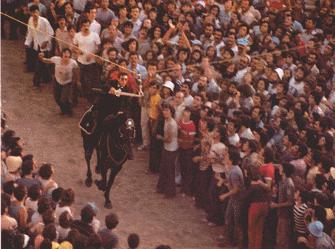
most important of which are to be found in Ciutadella on the island of Menorca, celebrated by the Caixer Pagesos, Caixer Casat, Caixer Fadri,
Caixer Senyor and Caixer Capellá together with cavaliers and flageolet players. The caracoleos is a celebration which takes place to the sound of
traditional jaleo music upon rearing horses and with games reminiscent of medieval times which lend a spectacular air to the festivities, now popular all over the island.
The feasts of San Juan, of the Mother of God or of Las Calderas are celebrated in Soria from Thursday to Monday, and each day has a different name: Thursday La Saca,
Friday de Toros, Saturday agés, Sunday de calderas, and Monday de bailas.
On 25th June in Yebra de Basa (Huesca) a pilgrimage is held to Santa Orosia with dancers taking part whilst the saint's skull is carried in procession.

 Back to Spanish Fiestas
Back Home