The nun Juliana of Liège used to have a strange vision every time she began to pray, which had been happening since her youth, in which a full
moon appeared with its centre darkened by a shadow. Finally it was Jesus Christ himself who told her of the significance of the vision which had become an
obsession for Juliana: the bright circle signified all liturgical celebrations and these were only darkened by the absence of a feast day dedicated to the
exaltation of the actual presence of Christ in the eucharist, which at that time was questioned by several sectors of the Church. Official recognition of the
feast day was given in 1246 in a synod called by Roberto de Torote, bishop of Liège. Urbano IV (who had been Archdeacon of Liège cathedral) issued
a Papal Bull in 1263 in which he decreed that the date of the feast of Corpus Christi would be the Thursday following the eighth day of Whitsuntide. Finally, in
1317, John XXII ordered that the Body of Christ should be part of a solemn, public procession and from this time on, the feast of Corpus Christi became more and
more widespread and popular.
The feast day arrived in Spain sometime during the 14th century, but it is difficult to establish the order of events with regard to this, although it would seem
that Girona and Barcelona were the first readily to accept it, followed by Valencia, Lleida, Seville and Toledo.
In the processions, the main feature is the Host, and this takes precedence over everything else, being housed in magnificent masterpieces of silverwork which
were fashioned by the Arfe family, father, son and grandson (all of whom worked in Spain), in the case of the processions which take place in Toledo,
Seville, Córdoba, Santiago de Compostela, Avila, Burgos and Valladolid.
Also relevant to this feast day, mystery plays began to be performed and although they have not been handed down in their entirety, several important subjects
have been added to the many representations. The struggle between Good and Evil, and between Heaven and Hell are performed in the danzantes y pecados
(dancers and devils) in Camuñas (Toledo), whilst in Laguna de Negrillos (León) it is Sebastián, leader of rogues, who is shown
together with Jesus himself, accompanied by St John the Baptist, James the Greater and all the apostles. In Oñati (Guipuzcoa) the brotherhood of the
Holy Sacrament (Santísimo Sacramento), formed in 1553, is also popularly known as The Apostolate and, as happens in Laguna de Negrillos, the performers'
faces are masked with the attributes typifying the characters on their hands. A group of dancers perform in each of these processions.
Also taking part in the processions of Corpus Christi there are some very sinister characters, such as El Colacho in Castrillo de Murcia (Burgos),
who according to some people represents the devil himself, who, fleeing at the sight of the Eucharist, passes over a huge mattress full of children, thereby ridding
them of any disease related to hernias. There are also devil figures in the celebrations which take place in Fuenlabrada de los Montes and Helechosa de los
Montes, both in the province of Badajoz, although here the main feature is to collect money and pursue the children.
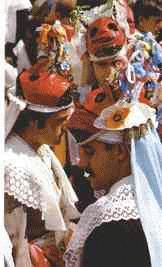
The processions which take place in Valencia and Morella (Castellón) are inevitably colourful, lively and baroque. All types of characters take
part in the celebrations --members of guilds and brotherhoods (the feast of Corpus Christi has always been closely linked to the guilds), dance groups, devils,
the virtuous, dwarfs, giants and eagles. In Valencia, mystery plays are performed on wooden floats called roques dating from 1413, although these are gradually
deteriorating and the plays are to be performed elsewhere. In the procession at Seville, the six choirboys of the cathedral have the privilege of being able to
dance before the Santísimo. Apart from the Gigantes y Cabezudos (giants and carnival figures with enormous heads), which are directly related to this
partiuclar feast day, the Host is accompanied on its journey through the streets (which are often covered by a carpet of aromatic herbs) by the carnival figures of
cocas (evil bogeymen), mulassas (carnival animals), and tarascas (dragons), and other carnival figures whose significance has been interpreted
in many differrent ways. In La Patum in Berga (Barcelona) Turks and Cavaliers take part, whose battles mirror the confrontations between Moors and
Christians, and also the following: diables (devils), which throw fireworks and rockets, the mulaguita or mulafera which is a type of enormous
animal with a giraffe's neck which breathes fire, dwarfs, giants, and finally the crowned eagle which represents royal power and freedom of the citizens from fuedal
landowners. In Redondela (Pontevedra) the main participants, apart from the dancers and mythical coca in the form of a papier mâché dragon,
inside which, half-frightened, half-amused children sit, are the burras and penlas. Burras are elderly ladies who dance, carrying a young girl
on their shoulders who is dressed in white with a starched skirt, the edge of which is held by the burra and is given the name of penla.
In Valverde de los Arroyos (Guadalajara) the Dance of the Cross is performed during the holy procession on the Sunday following the eight day of
Corpus Christi, and in Pollença (Mallorca) one of the events is the ancient guilds dance of Sant Joan Palos i les Aguiles.
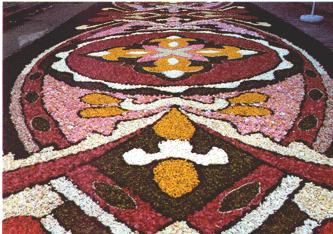
Although the custom is very old of covering the route which the Corpus must take with aromatic herbs, the so-called flower carpets, which are often great
works of art and beauty, appeared at a later date, and are now especially popular in Catalonia, Galicia and the Canary Islands.
Arbùcies (Girona), Arucas (Gran Canaria), Granadilla de Abona (Tenerife), La Laguna (Tenerife), La Orotava (Tenerife),
Las Palmas de Gran Canaria, Puenteareas (Pontevedra), Redondela (Pontevedra), Sitges (Barcelona), and Tacoronte (Tenerife) are
some of the places closely linked to this beautiful custom; in Arrecife, Guatiza, Haría, Los Valles, San Bartolomé,
Teguise and Tinajo, all on the island of Lanzarote, the carpets are made of salt, whilst in Elche de la Sierra (Albacete) they use sawdust
and wood-shavings. In Villa de Mazo (La Palma) they make carpets, passages, halls, and, most importantly, archways, along the processional route.
There is, of course, a vast number of other Corpus Christi celebrations, all of which would be impossible to mention here, but the following are worthy of note:
L'ou com balla (the dancing egg) in Barcelona; The Tethered Bull in Benavente (Zamora), which takes place the evening before the feast;
the Street Festivals of Capellades (Barcelona) on the eight day of Corpus Christi; Corporales in Daroca (Saragossa); paloteos in
Fuentepelayo (Segovia), also on the eight day of Corpus; the dances in Fuentes de León and the Brotherhood of the Holy Sacrament in Peñalsordo,
both in Badajoz; enramades in Sallent (Barcelona) La Festa dels Barris (Feast of the Town Quarter) in Sant Sadurní d'Anoia (Barcelona)
and a host of other commemorative celebrations which liven and enrich one of the three Thursdays in the year which shine out more than the sun itself.
 Spanish Fiestas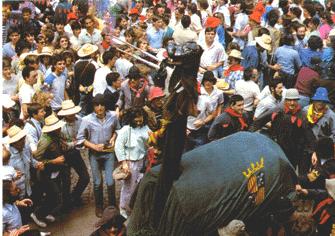

 Back to Spanish Fiestas