Andalusia which, from the point of view of cooking, comes under the heading of fried food, has a rich and traditional cuisine,
which may not be said of all of its nine provinces and which the traveller may not find easily.
The best wines of Spain come from Andalusia and belong to the long list of Spanish wines which are most famous abroad. The wines of
Jerez in the Province of Cádiz are the most renowned in universal literature, beginning with Greek texts of the 4th century BC, then Shakespeare etc., etc.
The system of production is unique and almost borders on the miraculous, for it is not a wine from a specific crop, as is the custom in other places, but
from successive mixtures made over the years. These wines are subtly different. Official classification recognizes ten types:
FINO. Clear, straw-coloured; dry, light and very fragrant. 15 to 17% alcohol
AMONTILLADO. A certain hazel nut flavor. 16 to 18%
OLOROSO. Dark Golden. Strong but light. 18 to 20%
PALO CORTADO. Between Amontillado and Oloroso. 18 to 20%
RAYA. Like the previous one, but less delicate
PEDRO XIMENEZ. Sweet with a high alcohol content
MOSCATEL. Sweet raisin wine
SWEET WINES. Obtained by adding alcohol to the grape juice which has hardly begun to ferment
COLOR. Obtained by fermenting fresh grape juice to which concentrated grape juice is added
MANZANILLA. Wine from Sanlúcar de Barrameda, which is very pale, very dry and has a high alcohol content.
These are wines that must be sipped slowly, and savoured in the course of a conversation with a tapa (a small portion of delicious food) or without.
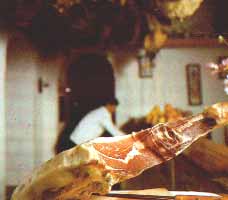
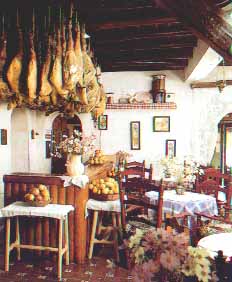
And after the wines, the ham. The best ham in the country is produced in Andalusia: the Jabugo in Huelva. It is unmistakable and definitely superior to any
other in the peninsula, although the ham from Trévelez in Granada is almost as good. Both should be cut and served in fine slices.
After this, the famous pescaíto frito (deep-fried fish) may now be discussed, which has two main capitals: Cádiz and Málaga, though it is
prepared everywhere in Andalusia.
In Cádiz, the fish is sold to the public in fish shops or at stalls, and it is impossible to give a definitive recipe for their preparation. It may be the way the
fish is cut, the temperature of the olive oil used to fry it or the special aroma which is produced by frying different species of fish together in the same pan:
mojarras (Diplodus vulgaris), sole, grey and red mullet, whiting.
In Málaga, fried fish is a different, but equally delicious treat. There, el boquerón (fresh baby anchovy) is king. It is fried in huge piles and
put on the plate where it resembles the "foam in the sea", as the tiny chanquetes (baby anchovy just born) have been called. Fried fish is also found in Seville
though there it is prepared in larger pieces and dipped in a special pastry called "adobo".
Another typical aspect of Andalusian cooking is el gazpacho, a favourite dish in the Spanish summer. It is a soup which is prepared in a thousand different ways,
though Córdoba probably makes the best. It consists of bread, oil, garlic and water and very often tomato. There is no reason why fresh pepper and cucumber should
not be added though they are not traditional.
Among the splendid variations, there is the Salmorejo of Córdoba, one of the traditional dishes which has managed to survive in the province. It is, like
all Andalusian gazpachos, a cold dish which consists of tomato, bread, olive oil, garlic and pepper and is served in the shape of a very hearty soup.
Special mention should be made of the typical gazpacho of Málaga called "ajo blanco" (lit.: white garlic), which is less common than the Andalusian
version, but is equally refreshing and much more original. It is made with oil, almonds and garlic and patiently prepared in the mortar until it becomes a paste to which
cold water is added. The final "touch" is provided by a few grapes.
With regard to heartier dishes, the Province of Cádiz comes first. Its cuisine is without
a doubt the richest and most varied in Andalusia. There in addition to the
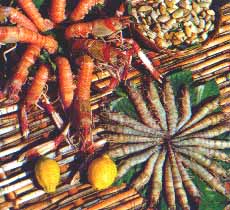
"pescaíto frito" and the best shellfish and molluscs along the coast (el ostión or giant oyster, prawn, shrimp, small clam, crab), there are
kidneys in sherry, pigeon pie, ox tail and squid with beans, apart from a very
popular and typical old stew with a proud name and unheard-of taste: el caldillo de perro (lit.: dog soup).
It is prepared in the local taverns where the fishermen live, and the outcome, half salty, half sour, is not at all easy to predict despite its few ingredients. It contains onions, fresh fish and orange juice.
Of the famous recipes of the Andalusian cuisine, dishes from Granada, the great cuisine of the area, are outstanding: las habas a la granadina and la tortilla Sacromonte. The former includes
Trévelez ham and el ramillete albaicinero, a bunch of herbs from El Albaicin including bay leaf, mint and parsley. This recipe, together with those of Catalonia, are the best ones for beans.
La tortilla Sacromonte is a festive omelette of extraordinary refinement which should never be mistaken for the so-called paisana which abounds on the menus of the restaurants.
The Sacromonte omelette is made with fried and breaded brain, lamb or veal testicles, potatoes, red pepper and peas. Everything is cut into small pieces and sautéed before adding the eggs. As a dish
it is almost a ritual closely linked to the gypsy cave dwellings in Sacromonte, after which it is called. The Granada tortilla is a variation of this omelette, but it is made with lamb sweetbreads, chicken
liver and kidney with white wine.
Another important Granada dish is a noodle dish called cazuela de fideos with beans and cod and a whole range of spices. And along the coast around Motril and Almuñecar, the popular
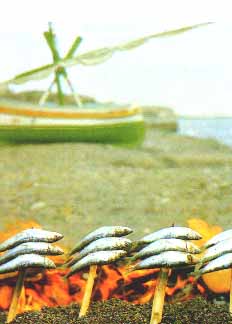
moragas de sardinas (fresh anchovies on a spit) are prepared. The fish is spitted whole, the stick is stuck into the sand and then hot embers are arranged around it to roast the fish.
In Almería, the cuisine is partly from Murcia and partly from Granada. The same can be said of another border province, ie Jaén. There the typical dishes are partly from La Mancha, Granada
and Córdoba. Spinach in a recipe of Jaén is one of the most popular dishes and is served with crushed dried peppers, garlic and gread crust, with a lot of olive oil, an element in the
province which produces most of the olive oil in the country. Therefore, oil is used freely with salads, as in the pipirrana, ie green pepper, onion, tomato and marinaded fish in small pieces.
In Córdoba the traditional recipes have largely been forgotten, while ox-tail stew, which is strong, greasy and very tasty, though reminiscent of bullfighting, has recently become the top regional dish.
There are also gazpachos as described and veal with artichokes, pigeons with olives and baked pig's trotters. Worthy of special mention are the wines in this province which have their own unique taste, capable of
competing with their famous neighbour, Jerez. The wines are dry, fragant and have a high alcohol content. They have an official Certificate of Origin (Apellation d'Origine): Moriles-Montilla, and there are four types:
finos, amontillados, olorosos and aged olorosos. The best wines are those which come from the Montilla mountains, the so-called Montilla Albero and Moriles Albero.
Another province which does not lag behind in terms of wines is Málaga with its famous moscatel, one of the best of Spanish productions. It comes from the grape of the same name, perhaps the most exquisite
in the world. Málaga wine resembles liqueur, has a warm taste and a dark colour. It is sold under many different names: Málaga, Málaga Virgen, Lácrima Christi, Pedro Ximenez...
Apart from the Jabugo ham, which is glory enough in itself, Huelva has some splendid fish dishes: red bream with onions, sardines with black pepper,
red bream in paprika, clams with rice and chocos in different recipes. (The latter are squid-like and typical along this coast. They are very tasty).
Finally, there is Seville, the official capital of these lands. The kingdom of the tapa, a delicious, small-scale hors d'oeuvre which comes from here and has successfully found its way
into every corner of the country. But no imitation has come close to the mastery of Seville in scope and variety of the ingredients.
The traveller who passes the test of the tapas in Seville will discover some important typical dishes. For example, the famous huevos a la flamenca, a simple, but wise recipe which can now be
found everywhere in Spain. Its preparation is delicate and it should be served as soon as it is ready. The eggs are put in the oven on a bed of tomatoes, chorizo, ham, green beans, fried potatoes, asparagus, red
pepper and peas, all cut into small pieces.
Another popular dish of Seville is tripe, called menudo gitano, el cocido a la sevillana (a stew), in which the meat is fried with beaten eggs, ternera a la sevillana, larded veal with wine and olives, and
finally duck with olives.
As for sweet dishes, Andalusia has an endless variety of obvious Arab origin, which are often admirably preserved by the nuns of the many convents in the area, especially in those of Seville.
Las tortas (oil cakes), which are sold everywhere in the country, are a typical breakfast in countless cities and are made in the convents. Los polvorones (which are typical at Christmas),
los cortadillos, with a pumpkin filling, los alfajores, mostachones (small cakes for dipping in coffee or hot chocolate) are among the traditional sweets as well as las yemas de San Leandro (egg yolks).
 Spanish Cooking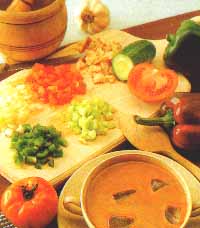

 Back to Spanish Cooking